There is a study, published on Aug. 10, in the British Medical Journal examining whether the articles published online, with comments, elicited any responses from the authors. There is a thoughtful blog post from The Scholarly Kitchen about this study. Article authors generally didn’t respond to critics, even if the critics were serious and wrote substantively on the matter. Interestingly, when the authors did respond, the critics were satisfied responses less than half the time. The editors of the journal generally accepted the authors’ rebuttal, and of course, it should be said that they did accept the manuscripts for publication.

The lead author of the BMJ study, Peter Gøtzsche, suggested that  the editors 1) may not be qualified enough to review the criticisms and and rebuttal and 2) have a vested interest in maintaining the reputation of the journal (i.e. defend the stance that the science they accept is high-quality.) I have this additional snarky observation. The critics may be especially unreceptive to the authors’ original paper and rebuttal because the original criticism stemmed from contradictions with the critics’ own work.

Just a thought.

I have a few other thoughts, and I would argue that we not judge the editors too harshly for, perhaps, mistakenly accepting “bad” science or perhaps not understanding the nature of the criticisms. There are actually acceptable reasons as to why some controversial papers get published.I have some insight into the editorial process; no juicy gossip or behind-the-scenes look at nefarious machinations, mind you.

I had applied to a scientific editor position at Neuron almost 2 years ago. There were two open positions and I came in, at most, “third” (and dammit, it was my dream job!) For the first stage in the application process, I had to review 2 papers from 7 categories, published in Neuron over year prior to the application deadline. I was to choose an example of a good paper and a weak paper (from the set of already peer-reviewed and published articles). I was also supposed to write about the neuroscience field, identifying authors whom I would invite to write a review (and I had to specify the topic) and where the next big thing will be (and who the leading lights are.) It was great fun to write, although I left myself only a week to do it (and of course I was working in the lab all that time.)

But I digress. Of the 7 fields, I can honestly say that I am an expert in, at most, 2 of the fields. And even then, that’s a stretch, because the fields were more general than a particular sensory system (I worked in olfaction) or even a technique (quantitative microscopy, epifluorescence and 2-photon laser microscopy). As one might guess, and as found out later, this is the norm for the editors there. The editors all have different backgrounds and at Neuron, and no one is asked to specialize. So every editor will be asked to triage manuscripts outside of their expertise and background. Presumably, this has the advantage of ensuring that editors remain aware of developments over a wide swathe of neuroscience.

I can’t say about other journals, but at Neuron, the editors have final acceptance/rejection authority. They decide whether the article is sent for review in the first place. Using the peer review, they of course defer to the expertise of the reviewers, but the editors’ job here is to be a disinterested party in unknotting the various interests reviewers and authors have. But the decision to accept a manuscript for publication is also determined by this amorphous concept of making a significant advance in the field.

There are several ways of looking at this: perhaps the researchers themselves ought to understand where their field is going and so are the best placed to assess where the cutting edge research is, or that that researchers have a vested interested to “sell” their research as hot – regardless of actual scientific worth, or that the editors are in no way prepared to decide on what constitutes a significant advance – as they no longer have direct experience with the difficulties and intractabilities of various experiments and models, or that the editors are in fact best placed to see what is a significant advance – by virtue of seeing so many good and bad manuscripts with overlapping topics from various competing scientists.

I am inclined to go with the fourth idea, that good editors can observe developing trends from manuscript submissions. And if you look over a year’s worth of articles, from one journal, I also could see blocks of papers with similar topics (or at least similar keywords.)

I think the stewardship/peer-review system works, although I am not opposed to the more open style of publication like the Public Library of Science (PLoS) journals. These latter focus more on technical soundness; the reviewers try to make sure that the experiments support the conclusions, as is the norm. However, no editors are in place to reject papers because of a lack of perceived significance. The idea is that scientists will eventually cite this paper heavily – or ignore it – depending on its actual value; it is assumed that the cream will float. Again, I have nothing against these different modes of publishing.

During my interview with Neuron’s scientific editors, we discussed our reasons for wanting to become editors and problems that may arise during the adjustment phase. One potential downside is that no longer will an editor be recognized as an authority on any subject, and rightly so. The editors would no longer be in the trenches, won’t be adding any new techniques to his repertoire. However, I defended the idea that editors simply replaced one expertise with another. As I said above, a good editor becomes an expert in spotting over-populated and under-served topics. And the nature of the beast is that they would in fact see many, many similar manuscripts. They have the luxury of establishing a baseline level of quality and significance.

Well, I didn’t get the job, but I remain sympathetic to their roles. I think there is a need for the so-called gate-keeper role. The fact that someone took the time to place a science manuscript in the context of all the work that has recently been done lends an imprimatur of worth. Of course editors do not get it right all the time. But one can at least count on Neuron, or Nature, or Science, or Journal of Neuroscience publishing papers that presumably compared favorably to some cohort of papers. That takes judgment, and the editors read the manuscripts that you may not have time for.

My point here is that editors can misjudge the value of a piece of science, but that is no reason to think they add nothing of value. They do not necessarily have to defend their choices, at least not at the level of single papers. Remember, just as the editors themselves may have idiosyncrasies, so do the readers that read the articles. The scientists themselves also have different intellectual sharpness, shall we say. But, over time, if editors do consistently “get it wrong”, then it would in fact be obvious. The room for subjective assessments of value can only go so far. Techniques converge at some point, even if the systems scientists work on differ. Each experiment generates a control for comparison, anyone wishing to extend work generally tries to reproduce results – to show that they are doing something right, and the level of citations are all spot checks for the soundness of the science. At some point, missing experiments or graphs, other scientists complaining about articles whose results cannot be replicated, or few citations become problematic for a journal trying to maintain its luster. And the scientists themselves can start to ignore the offending journal by submitting to competing journals.

But, at its most basic, one wouldn’t expect an editor to be aware of the details raised by critics. Simply, the details are probably only important to the investigators and deal with “procedural points” (as an example, do you really care that an animal “sniffs” rapidly not to gather more odor molecules to increase signal-to-noise but rather to attenuate background smells – in order to increase signal-to-noise? Or that this is something imposed by behavioral modulation rather than centrifugal modulation of the olfactory bulb? See Verhagen et al, 2007.)   I guess it is fair to say that editors are “big picture” people. With that said, perhaps there is some way the editors can facilitate the discourse that occurs in the comments-sections that are now de rigeur.
I was talking to my sister in law about some gossip in Anthony Bourdain’s Medium Raw, when she stopped me and asked, rather sensibly, why I was reading him, when there are so many angles on how humans mediate their experience with food? And isn’t the whole book simply one man’s opinion? What worth does it have?  What could I have learned from the book? And finally, why him? I had the same thoughts while reading the book, and I think this line of questioning is a good outline for this essay.
Yes, there are more important topics about food that transcend the behind-the-scenes look at restaurants. For instance, can’t we talk about the (mis)management of fisheries, the shrinking variety of diet, the amount of land dedicated to sustaining our beef supply, the threat of monoculture to our future food supply, the use of transgenic crops, the class gap between nutritious food and fast food, the need to lower the amount of meat in our diet, the inability to mitigate starvation, the fact that subsistence farmers still have to make a choice between cash crops (poppy, tobacco, and coffee) and food crops, and the unequal distribution and cheapness of fresh water in the first world (and the scarcity thereof in developing nations).
Further, there are so many other more pressing issues, who cares if there are bad chefs and good chefs, whether food critiques and chefs trade favors for good reviews, and pornographic descriptions of food? This question, it seems to me, can be interpreted as, with so many pressing problems in the world, why is it that I am occupying my free time with entertainment, which, would include both high-brow and low-brow culture? This isn’t meant to be a slam; even as I was reading Medium Raw, I had thought the same. In the end, the book was a fun read, and I stuck with it. Simply, that was the pay off.
But the question is worth exploring. I suppose the answer I would have, in general, as to why I would spend time on any type of entertainment, whether it be  reading novels, watching movies, listening to music, going to concerts, or spending time with friends and family, is that experiencing something different may provide the mind with another type of agitation. When I seek out something different, I am hoping for chance opportunities to arise where new connections are formed between ideas where none had existed before. It’s also the same reason I would revisit something I did not like; I cannot assume that new ideas wouldn’t foment, or that it wouldn’t strike me in a new way. I don’t expect this to be an appealing answer for everybody, but it is my rationale for reading, essentially, trashy reading. Sure, I finished Medium Raw because it was fun, but I was certainly hoping to see some thing unique and perhaps an observation or two that alters some of the thoughts I already have connected in my head.
Yes, the book is one big opinion piece. However, it is clear that, whatever Bourdain’s experience or talents, he loves food and the people who prepare it. At his best, he provides observations about how kitchens work, providing actual details of things cooks do. He spends a chapter on career trajectories. He spends another chapter on a prep cook at Le Bernardin, responsible for turning whole fish into cuts that chefs can use. There is a fair amount of introspection about the nature of high-end food (there is a lot of waste; if the chef is honest, the high costs results from the throwing out less-than-perfect items.) There are some more observations about the types of local food available in Vietnam (it seems that’s his favorite food experience). He talks about some of the characters in NYC restaurants. He writes about food trends. He’s also realistic about the role and position food critics play in shaping public opinion; even someone of Eric Ripert’s stature, a 3-Michelin star chef, is aware of the need to play to this audience. Surprisingly, Bourdain and Ripert do not appear contemptuous or condescending and actually acknowledges that, to be successful today, one cannot reject them. In fact, it is a good thing to have a sophisticated audience who would buy this food. There’s even a nice chapter on the silliness of removing home economics when the focus should have been on forcing this education on both sexes. Instead, we are left with kids who can neither make sandwiches or balance a checkbook.
Bourdain is at his best when describing what he sees, how people do things, and what people have done. There are food porn aspects, like when he’s trying to give some vignettes of the places he’s visited and descriptions of how food tasted during his work with Food Network and Travel Channel shows.
Some annoying moments came when he twisted knives that he had stabbed in various people, way back in his other memoir, Kitchen Confidential. Kitchen Confidential was a tirade, here, he tries to reconcile his feelings and place his criticism in context. Surprisingly, this part didn’t  bother me so much. His take downs of Alice Waters and Alan Richman seemed cogent; mostly, he stuck with actions. He didn’t like what Waters and Richman did, and he let readers know it was. This point is worth mentioning because it was so… considered.
Look, of course what Bourdain thinks of either chef is pointless. He’s just trying to justify his feelings. I did like seeing him squirm, but on balance, if I lose it and decide take down someone, I hope I am level headed enough to stick to the facts. Bourdain could have done the opposite, simply running up a string of adjectives and insults. It is important to sort the statements he makes: Bourdain did juxtapose a series of actions that made a logical, coherent argument. This type of reasoning is distinct from simply calling names. I admired the way he wrote out the argument, even if I didn’t care for his conclusions. Despite these sections being too insular, I thought Bourdain spent a bit of time crafting his argument, which is all I  ask for.
It is worth noting that he tempered some harsh words was on the subject of vegetarians. This part rang hollow, if only because the following argument seemed so small given the insults he wrote in Kitchen Confidential. He argues here that  he gets annoyed at the way a vegetarian abroad would essentially be breaching etiquette and hospitality by refusing the standard fare of other cultures. In Kitchen Confidential, his rant was simply against an all-vegetables diet (and it was a string of adjectives and insults, not really a coherent argument). So it struck me as odd.
I think to sum up why I read Bourdain, and not someone like  Mark Ruhlman, is that I find Bourdain smart, funny, and a good writer. I enjoyed his take on food (I think Ruhlman, for example, is also smart and a good writer, but I didn’t take to his style. It was too serious and too sincere, lacking the joviality of Bourdain’s writing). Even if I didn’t care for some of the gossip, he engaged my interest. I am glad to read Bourdain because he has passion; he values food and the people who cook it. He wishes to treat their work as something worthy of meaning and deep consideration.
Why read a book of opinions and judgements? Well, Bourdain has an informed opinion about food. Finding out how he thinks is more important to me than his conclusion. This is the main reason I am blogging so much; I simply wish to write about the connections and thoughts I have, when I read. One way of teaching oneself is to explain something to others. Writing helps me organize my own opinions on something. My verdict of a book (whether it’s a thumbs up or thumbs down, whether it’s a “A” or an “F”) is besides the point. The thoughts evoked are much  more important. In much the same way, I wasn’t reading Bourdain to see which restaurants are worth making reservations for. He has the access to see experienced, well-respected professionals at work. He observes and reports, and by this, I gain a deeper appreciation for the art and craft. Yes, I do want to go to Le Bernardin, but only because Bourdain gave it a context that appealed to me.
There is also another point worth making: one doesn’t have to be immersed in a topic to write about it. It helps, but in the end, research, observation, and a sincere desire to learn and tell the story in a considered manner will carry one a long way.  The converse is that just because someone is an expert in the field, it does not necessarily make him the best person to write. Of course, I mean this in a fairly narrow way: chances are, that expert will be able to communicate to his colleagues. He may not have the skills to communicate to a different audience (that is, to laymen.) One could argue either way against Bourdain: he freely admits he could never cook as well as his friends (in terms of creating new dishes.) By his own admission he isn’t a Thomas Keller or Grant Aschatz, two leading lights of American cooking. But he has spent over 25 years cooking, so he isn’t someone who is merely enthusiastic about food. Depending on how one thinks of Bourdain, that’s a good thing or bad thing. I am writing here that I think this argument is irrelevant. The worth of Bourdain can be evaluated simply by the quality of his arguments. Good writing can come from anywhere.

http://www.teleread.com/ebooks/in-the-face-ebook-errors/

A writer at Teleread, who also had nearly 30 years experience as a publisher, suggests that proof reading is even more critical for ebooks than paper books.

Koa Lani, an author, has written an interesting critique of Jodi Picoult’s observation that modern, notable, literary writers tend to be white and male. Lani offers a response: perhaps the quality of writing, from other sources, is in fact lacking.

I came across a strange post from Lev Raphael, over at Huffingtonpost.com. He tried to correct something Jodi Picoult wrote in her dismissal of the New York Time book critics. Over Twitter and interviews, Picoult pointed out her feeling that the NYT critics are biased in whom they select for discussion. The most recent literary author deemed fit to print is Jonathan Franzen. [Picoult had also previously discussed this point with Jason Pinter and Jennifer Weiner at the Huffington Post .]

The controversy, such as it is, reflects the hardline stances and lack of nuance in media. It is a controversy made of nothing more than opinions that every side here is entitled to. Picoult admitted she never did a count of how often white, male writers from Brooklyn were reviewed and acclaimed. She was simply being snide. The NYT can publish on whomever they wish. And kibbitzers like Raphael and I can add our own bits.

The one tossaway line I wanted to focus on is Picoult’s line that book reviews ought to focus on popular literature, even more so than literary fiction.

The specific thing I wanted to write about is Raphael’s response to this statement. He noted that Jane Austen, for example, was not popular in her time. Readers gravitated to her and parted with money from their pocketbooks only after her death. Basically, Raphael was correcting the idea that Austen was “popular” during her life time.

I think Raphael misread this statement. Picoult wrote

… the books that have persevered in our culture and in our memories and our hearts were not the literary fiction of the day, but the popular fiction of the day. Think about Jane Austen. Think about Charles Dickens. Think about Shakespeare. They were popular authors. They were writing for the masses.

Picoult’s point is much simpler. The authors did not separate the idea of worthy, meaty big-L literature from writing something that was a smooth read, snappy, and contained plot. That is, there was no distinction made between novels targeted for the critics and for the masses. I have felt that this idea is missing in modern literature. I had always assumed that what we call the classics (and generally I place the fracturing of a consensus canon to post-Hemingway literature) grew organically from fiction of  the times. That is, critics could only select on what was published, and frankly, our forebears were extremely focused on what sells.  This seemed a happy middle ground, where the novels were written to appeal to the masses. Critics rode shotgun over this process, trying to cultivate some sense of sophistication in how readers were to receive and understand literature.

As B.R. Myers has noted, though, there has been a change in attitude among modern writers, codified by the elevation of the serious, difficult fiction above works that are written for the masses. Nevermind who decides this to begin with. I find it disjointed that we now look askance at books that are entertaining, as if somehow it cheapens the linguistic fireworks and ideas that might be contained (and Franzen makes the same point.)

To be clear, I am not writing that authors – both modern and past –  never gave a thought to their legacy. Of course they did, but above all, they wrote books that people (eventually) wanted to read. Everything else follows from that. There was no separation of purpose: they wrote for the sale, and if they had ego and pride, they wrote to last.

Even when Jonathan Franzen first made headlines with The Corrections, I found the discussion rather pretentious. Apparently, everyone was focused on how he was one of the first to capture a slice of society, in all its messy complexity. My first reaction was, did Wharton, Thackeray and Tolstoy not accomplish something similar? Upon reading it, after rolling my eyes at the requisite number of disjointed paragraphs and awkward phrasing, I thought the best thing about The Corrections was that Franzen wrote about a family of assholes, but that each person was an asshole in his or her own way. I thought Franzen’s technical mastery was in his characters*, since writing in distinct voices is hard.

*For an example of a less successful instance, see Orhan Pamuk’s My Name is Red (and just to be fair, the distinct voices may have suffered from translation, so I’ll spread the blame here to include Erdag Goknar, the translator.) My Turkish friend did feel the same way, although I need to ask if she read it in Turkish or the English translation. So Goknar may yet be taken off the hook!

The worse thing to happen to any field, let alone literature, is that things must be “difficult” to be worthwhile (and Franzen agrees!) The idea that modern physics is a mind-trip was mistakenly interpreted to mean presentation rather than the ideas being explained. Somehow, this type of thinking infected critics and writers alike. So we get difficult prose (something Myers expounded upon), obfuscating stories with barely a plot, poor character development, and less than imaginative ideas.

Using scientific papers, published in academic journal, is a poor method to show how difficult ideas can be conveyed simply. These papers  are short, and many scientists are poor in compressing complex information in a easily read manner. I would suggest anyone examine the books of Howard HughesRobert Sapolsky, Dave Berri, Brian Greene, Daniel Dennett, and Jared Diamond for examples of how complex ideas and details can be presented in a straight-forward way.  It bears repeating: the difficult reading in science has nothing to do with the writing but in the ideas themselves. Obfuscation is the enemy. To properly convey nuance and technically complex experiments, one needs to be extremely concise and clear so that others can focus on the data and conclusions.

To my mind, modern authors deemed to be of the literary type do the exact opposite. They dress up simple plots (boy meets girl, girl protects self, man-as-boy-then-grows up) in “difficult” language that a satirist would sooner write in that style than to write a mockery. There are only so many plots. What I would focus on is good writing and that kernel of observation that separates one book from another. I wish I were an editor or a book critic; as it stands, I read about 5 books every 2 weeks. Even reading so few books, I have a sense of what passes for good writing (Robert Bolano + translator: good; Don DeLillo: not so good). I can honestly say that although, there are books  I found “difficult” to get through, it wasn’t due to my lack of comprehension or inability to grasp metaphors. No,  I have read their language and found it wanting. So much so that I sometimes question the intellect of the writer.

Part of this disconnect I have with modern literature may stem from my wanting to write like Wharton and Thackeray. Modern authors like Mark Helpern also appeal to me. I much prefer to read a novel and not notice the language until the epiphany in the middle of the book, when I ask myself, how exactly did the author write this? Prose can be complex and difficult, but I have no problem following the authors’ thoughts. Of course, one can fail spectacularly in writing in this style: the writing would become so one dimensional that it leaves little room to the imagination. At this point, the novel would pass into the realm of an essay.

I admit that I am probably being a curmudgeon by my attitudes against modern writers and their scattershot writing style, hoping that words dropped onto a page somehow stick. Impressionism works as a visual art  form, not so much for prose (a point discussed in Myers’s book.)

I’ll just end by saying that, at its most basic, I object (and I echo Picoult here) to the divide that modern critics and so-called literary writers created in viewing mainstream books as a distinct creature from literary fiction. I much prefer to be surprised and awed by the writing in an entertaining book than to be disappointed by a “literary” novel that neither entertained nor stunned me with its language.

Punditry was something quite removed from my work life and home life. I avoid the detritus that passes for political analysis in the United States, choosing instead to focus on long form articles in The Atlantic, the NYT Magazine, and The New Yorker. I am surprised at one “holy war” (*nix vs. Win vs. Mac style) that has cropped up regarding ereaders.

Emma Silver is one of the latest to defend paper books against in silico texts. My acquaintance, Chris Meadows, has written a response to it; these two provide a snapshot of the types of arguments slung by both sides.

Generally, most partisans talk up the virtues of either paper or e-books. That is, they defend the form used by readers to engage authors.

My problem with these arguments is that neither side focus on the real issue. Reading is not a competition between old-school curmudgeons and bleeding-edge tech heads. Reading is being assaulted by demands on our attention by video games, movies, television, music, and time spent with friends and families. Whether one goes to a concert, a theater, sits on a couch, in a bar, or use the Internet is besides the point. Again, it is not the how one obtains entertainment that matters, only that, with the limited time we have, we seek other types of entertainment.

In this context, I do not see e-readers (whether it be Kindle, Nook, or a software reader on an iPhone/Android phone/netbook/PDA) competing against paper. The e-readers are competing against the devices people use to listen to music and watch movies on the go. That is why I think it is in every book lovers interest to promote long-form reading, and to defend this form from subversion.

No one can predict how devices like the Kindle will affect the novel and historical scholarship, two types of writing I would classify as most endangered. There will always be a demand for light fiction. There will always be people who seek out information and political interpretation from sources with whom they already agree with. There will always be a demand for hack and slash biographies providing salacious drug and sex habits of the rich and famous.

Novels and histories require an immense amount of attention. I can see that histories will become more “multimedia” in the future. Histories already are: photographic plates and maps are generally included, along with charts, even in paper versions. As the recent future recedes, we will be able to include more news and sounds. And why is this a bad thing? For instance, why wouldn’t we want to hear Churchill speak? He was a brilliant writer and a speaker; how wonderful would it be if a discussion of his service during World War II also provided aural examples of his rousing speeches to raise British morale?

The problem with anti-technology screeds is that they ignore the proscriptive phase of the argument. The solution will never be, let us ignore the device. It is already too late: the devices are too popular. I see the Kindle becoming the paperbacks of the ebook world: it cannot not yet do video. The iPad and Android tablets will drive ebook development, not the Nook or the Kindle. These will provide the basic platform for how texts are presented to the public.

And there is a real fear here that long-form reading will be lost, since it is so attention-intensive. The defense of reading will be successful only if we can persuade youth to turn to long form (paper and electronic) books when they desire knowledge and thoughtful analysis. That is where we all need to focus our efforts; to teach the young that, for some things, they need to sit, read, and think. We need to increase exposure of historians who write with brio and panache. We need to convince future readers that long form books are still relevant, providing the best method of compressing knowledge and complex ideas (as opposed to the fact and information based content stored in databases and across the Internet.) If an e-reader is how the youth today will engage with long texts, then we need to do more to insert ourselves into the processes by which books and their presentation is brought to the public. The paper versus electronic format as a diversion. We cannot afford to lose to the perception that long books belong with the dinosaurs.

Although this blog is ostensibly about books, I’ve written a lot about sports, mostly dealing with how non-scientist readers perceive statistical analysis of athlete productivity. This issue fascinates me; I think how people think about sports statistics provides a microcosm in how they may respond to similar treatments in the scientific realm. Economists, mathematicians, engineers and physicists will provide a better explanation of the analysis than I can. Instead, I want to focus on the people who draw (shall we say) interesting conclusions about research.

In a recent podcast, Bill Simmons interviewed Buzz Bissinger on the BS Report (July 28, 2010). Bissinger gained some negative exposure as he had railed against the blogosphere and sports analysis. In this podcast, Bissinger was given some time to elaborate on his thoughts. He most certainly is not a raving lunatic, but he did say a few things that I find representative of how statistical analyses are often misinterpreted by non-scientists (and  even scientists.)

Bissinger took the opportunity to trash Michael Lewis’s Moneyball, mostly by pointing out how Billy Beane isn’t so smart, and that all in the end, the statistical techniques didn’t work – only Kevin Youkilis – mentioned in the book, had proven to be a success. I think that misses the point. Yes, the book documents the tension between the scouts and the stat-heads. I think Lewis chose this approach to make the book more appealing, by taking the human interest angle, than simply writing a technical description of Beane’s “new” approach. Perhaps Lewis overstates the case in showing how entrenched baseball GMs were in relying on eyeball and qualitative skill assessments, but the point I got from the book was that: Beane worked under money constraints. He needed a competitive edge. Most baseball organizations relied on scouts. Beane thought that to be successful, he needed to do something different (but presumably had some relevance) to provide baseball success.

Beane could have used fortune tellers; I think the technique in Moneyball (i.e. statistical analysis) is besides the point. Beane found something that was different and based more of his decisions on this new evaluation method. This is a separate issue from how well the new techniques performed. the first issue is whether the new technique told him something different. As it happens (as documented in Moneyball,  Bill James’s Baseball Abstracts, and by many sports writers and analysts), it did. The result is that Beane was able to leverage that difference – in this case, he valued some abilities that others did not – and signed those players to his roster. The assumption is that if his techniques couldn’t give him anything different from previous methods of evaluation, than he would have had nothing to exploit.

The second point is whether the techniques told him something that was correct. And again, the stats did provide him with a metric that has a high correlation with winning baseball games – the on-base percentage. So one thing he was able to exploit was the perception in value of batting average (BA) versus on-base percentage (OBP). He couldn’t sign power hitters: GMs – and fans – like home runs. He avoided signing hitters with high BA and instead signed those with high OBP.

This led to a third point: Beane can only leverage OBP to find cheap players (and still win) so long as there were few GMs doing the same. Of course the cost of OBP will increase if others come onboard and have deep pockets (like the Yankees and the Red Sox.) So Beane – and other GMs – would have to become more sophisticated in how they draft and sign players. Especially if they work under financial constraints. As my undergraduate advisor said, “You have to squeeze the data.”

One valid point point Bissinger made was that the success of the Oakland A’s coincided with the Big Three pitchers. So clearly, Bissinger wrote off a significant amount of  Oakland success to the three. That’s fine, as the question can be settled by looking at data. What annoyed me is when readers do not pay attention to the argument. I just felt that Moneyball was more about how one can find success by examining what everyone else is doing, and then doing something different. The only constraint is whether  something different would bring success.

I felt that Bissinger is projecting when he assumes that using stats means the rejection of visual experience. The importance of Moneyball is in demonstrating that one can find success by simply finding out what people have overlooked. Once the herd follows, it makes sense to seek out alternative measures, or, more likely, to find out what others are ignoring. If the current trend is on high OBP and ignoring pitchers with a high win-count, then a smart GM needs to exploit what is currently undervalued. Statistics happens to be one such tool – but it isn’t the only tool.

And part of the reason I write this is, again, to highlight the fact that people usually have unvoiced assumptions about the metrics they use. The frame of reference is important. In science, we explicitly create yardsticks for every experiment we perform. We assess things as whether they differ from control. It is a powerful concept. And even if the yardstick is simply another yardstick, we can still draw conclusions based on differences (or even similarities, if one derives the same answer by independent means.)

This brings me to recent Joe Posnanski and David Berri posts. The three posts I selected all demonstrate  the internal yardsticks (hidden or otherwise) that people use when they make comparisons. I am a fan of these writers. I think Posnanski has provided a valuable service in bridging the gap between analysis and understanding, facts and knowledge. Whether one agrees or disagrees with his posts, I think Posnanski is extremely thoughtful and clear about his assumptions and conclusions, which facilicates discussion.  The post has a simple point: Posnanski wrote about “seasons for the ages.” A number of readers immediately wrote to him, complaining about how just about anyone who hits 50 home runs in a season would qualify. To which Posnanski coined a new term (kind of like a sniglet) – obviopiphany.He realized that most people simply associate home runs with a fantastic season for a hitter. That isn’t what Posnanski meant, and in the post he offers some correction.

The Posnanski post has a simple theme and an interesting suggestion: the outrage over steroids may be due to the fact that people assume that home run hitters are good hitters. Since steroids help power, the assumption is that steroids make hitters good – which in most cases simply means more home runs. But Posnanski – and others sabermetricians – propose that one must hit home runs in the context of getting fewer strikeouts and more walks. The liability involved in striking out more, and not walking, is too much and washes out the gains made from hitting the ball far. Thus Posnanski posts names a 5 players who are not in the Hall of Fame, and aren’t home run hitters, but who nevertheless produced at the plate – according to some advanced hitting metrics. I won’t go into this more, except to say that here, Posnanski makes his assumptions clear. He uses OBP+, wins above replacement player, and other advanced metrics to make his point. But it is telling that Posnanski had to stitch together the assumptions his readers had – that the yardstick for good hitting simply boils down to home runs.

The Berri posts describe something similar. One of them is from a guest contributor, Ben Gulker, writing about how Rajon Rondo was not going to be selected for Team USA in the world championship because he doesn’t gather enough points. The other highlights how the perception of Bob McAdoo  changed as a function of the fortunes of his team. Interestingly enough, McAdoo became a greater point getter while becoming a less efficient shooter and turning the ball over more; at the same time, his reputation was burnished by the championships his teams won.

The story has been told many times by Berri. It seems that in general, basketball writers and analysts associate good players as those who score points (in the literal sense, regardless of shooting percentage) and who played on championship teams. There are several problems here. Point getting must take place in the context of a high shooting percentage. One must not turn the ball over, one must rebound, one must not commit an above average number of fouls, and hopefully get a few steals and blocks. I don’t think anyone would disagree that such a player is a complete player and ought to be quite desirable, regardless of how many championship rings he has or if he scores only 12 points a game. Berri has examined this issue of yardsticks, and he has found that what sports writers, coaches, and GMs think of players has an extremely high correlation with, simply, how many points they get (this is shown by what the writers write and how they vote for player awards, how often coaches play someone, and how much GMs pay players.)  The verbiage writing up about the defensive prowess and the “little things” are ignored when the awards are given and fat contracts handed out. Point getters get the most accolades and the most money.

And the other point is how easily point getters reflect the luster of championships. Nevermind that no player can win alone, but this again is an example of how people end up with not only unspoken yardsticks, but also choose a frame of reference without analyzing if it is the correct one. The reference point is a championship ring. As has been documented, championships are not good indicators of good teams. The regular season is. This is simply due to sample sizes. More games are played in the regular season. Teams are more likely to arrive at their “true” performance level than in a championship tourney with a variable number of games – and frankly where streaks matter. A good team might lose four games in a row, in the regular season, but they may lose only 10 for the year. In a tournament, they would be bounced out if they lose four in a series.

In this context, the Premier League system in soccer makes sense. The best teams compete in a regular season; the team with the best record is the champion. So people who assume that a point-getter who plays on a championship is better than a player who shoots efficiently (but with fewer points) and rebounds/steals/blocks/does not turnover above average, and on a non-champion team, make two errors. They selected the wrong metric twice over.

With that said, I could only have made that point because of newer metrics that provide another frame of reference. Moreover, the new metrics tend to have improved predictive abilities over simply looking at point-getting totals. Among the new metrics, there are some that show a higher correlation with the scoring difference (and thus win/loss record) of teams. It doesn’t matter what they are, but an important point is that one can derive these conclusions about which metric is better or worse.

This is the main difference in scientific  (of which I include athlete productivity analysis) and lay discourse. In the former, the assumptions are made bare and frames discussion. A good scientific paper (and trust me, there are bad ones) makes excruciatingly detailed descriptions of controls, the points of comparisons, any algorithms/formulae, and how things are compared. In the lay discourse, this isn’t the standard one would use, because communicating scientific findings to other scientists use a stylized convention. Using such a mode of communication with friends would make one a bore and a pedant – not to mention one would become lonely real quick.

There is a recent flap, documented by Roger Ebert, regarding movie reviews of Inception, a Christopher Nolan film. The principals are Ebert and New York Press critic Armond White. It was generally accepted as a good movie. The Internet mob took issue with the few critics who panned the film. Ebert found himself defending the right of a negative review, provided that the review brought some insight that transcended a rating. The true issue is whether the critic was simply being contrarian, seeking to drive interest in his musings. Ebert also made the point that the mob mentality online is driven less by interest in the artistic quality of a movie than by the base desire to belong to a tribe. In this case, the tribe one joins have like opinions.

The short attention span promoted by web interfaces also feeds into the need for quick verdicts. Ebert and the contrarian critic both made the point that “me too” comments are drivel. There is a need for sensible and intelligent commentary. However, Armond inflames the discussion by saying that this commentary should only be supplied by gatekeeper critics. I think that this is the absolute wrong place to draw a line.

For one, the two are talking about movie criticism. It isn’t rocket science. There is very little basis in fact; most reviews worth reading seem to involve interpretation. I read through some of Armond White’s reviews; they appeal to me because he seems to engage the film as is. Sure, his verdict seems clear, but he treats the film as something worthwhile to discuss. Even in a simple actioner, such as Angelina Jolie’s Salt, White manages to find the political stance in the film to be atrocious, nevermind the plot holes and muddled action shots. The film has Jolie killing American CIA and FBI agents, who are bumbling idiots. White is outraged that this point of view, such as it is, isn’t explored in any way aside from being the backdrop for fantastic fight sequences.

White picked the wrong fight, I think. Commentary is open to anyone with who can see and can write. The additions that a professional writer offers pertain to facts about how the movie is constructed, access to the participants, and historical perspective and context. I have my doubts about the primacy of critics to the last item: perspective can come from anyone who has made intensive study of film. No one can see every movie made. In a sense, the fact that critics must choose among films open themselves up to the possibility that a dedicated amateur may actually know more than the critic in some limited sphere. This is the nature of the beast. Movies are made to be seen, and many people have access. I am not discounting the role of critics. I am suggesting that the difference between an amateur commenter and a professional critic is a matter of degree. The professional will in general have seen more films and read more and talked to more actors and directors than an amateur. They will generally have a better idea of the evolution of technical aspects of movie making, and of the philosophies governing how shots are framed, how actors and objects are blocked, and how edits are decided.

Despite the professional’s likely possession of an immense store of experience, it still  would not surprise me to see dedicated amateurs provide professional quality insight. One might think that since I am a scientist, I may actually exclude a few favored domains from this idea that an amateur can accomplish something useful. That is not the case. The history of science is littered with serious amateurs, who nonetheless gave much care in framing testable hypotheses, designed pertinent experiments, and had made careful observations and calculations about the data. Of course, the level of precision in gathering scientific data has increased due to both the quality of equipment and the wealth of scientific knowledge that requires integration. These factors limit a modern dilettante’s access to perform science.

But access to scientific literature remains, and in some cases has increased, from even 5 years ago (think of open access journals like PLoS One). There is much room for amateurs, and even scientists, to comment on fields outside of their specialty. As matter of fact, this is healthy, as it promotes awareness in the state of science as well as providing a shared basis for intellectual discourse.

What struck me as the wrong note, then, is that Armond’s dismissal of Internet commenters is that it smacks of elitism, rather than a defense of merit. Elitism assumes a position of superiority, while merit requires one to earn that privileged level. Only in form does Armond’s argument seem to defend intellectual discpurse. I would hazard that his type of discourse is the antithesis of intellectualism, calling for argument from authority and not through reason and rhetoric.

I have been a fan of the written Roger Ebert for sometime. I had always thought his written reviews conveyed a better sense of experiencing and watching the reviewed movie than his capsules on Siskel and Ebert or Roper and Ebert. Armond specifically decries this latter form of review, with simple descriptors followed by a thumbs up/thumbs down verdict. Thus, when I came across a toss-away line in Jacques Barzun’s From Dawn to Decadence, about how modern culture is sliding to its nadir because of a movement away from  dramatic tension and catharsis, I disagreed with him. The main issue isn’t whether Ebert is qualified or not. The issue is that, in the course of making a television version of a film criticism, the form provides constraints that, in essence, “dumb down” the review.

Ebert, and White, and Barzun, all come across as thoughtful people who are excellent writers and who are passionate about their subjects. Something is lost when these experts go in front of television cameras. As Neil Postman points out in Amusing Ourselves to Death, television isn’t bad because of a sinister TV and advertising executives. TV can be bad because the process that make compelling, watchable TV shows isn’t the same for what makes for a compelling book. Postman augments Marshall McLuhan’s statement that the “Medium is the message” by clarifying that the medium is crucial in framing how the message is conveyed. TV, and movies, generally require cuts, motion, changing camera angles. The setting needs to change frequently. Most importantly, speech cannot be in the form of lectures; they must be short phrases, captions for the attendant graphics and music. In short, this is the opposite of what occurs in textbooks or scholarly works – and even in magazine or newspaper articles.

Again, the point isn’t that TV has no redeeming value. The fact is that different media have different advantages and limitations. Such limitations would restrict even the most serious scholar who wished to elevate discourse. TV isn’t suited to intellectual discourse. How can 5 minutes of discussion, in a round table format, equal the depth in a few chapters of a history, or economic and political analyses? Thus, I found White to have picked the wrong fight. It isn’t that there are better critics than Ebert; White’s issue is, I think, with the television format.

On a final note, related to how TV changes the presentation, I will recount my conversation with a dancer. I had just met her, and since she told me she is a dancer, I asked her what she thought of shows like So You Think You Can Dance (one of my favorite shows.) Her complaint is similar to just about every afficionado who sees his subject thrown up on the screen: the television doesn’t convey the depth, the technique, and the nuances of the subject. She thought that the 3 minute dance segments did not convey the technical aspect of dance, one important component of which is that some pieces are long – stamina and attention are requirements. The voting system, by untrained audience members, skew votes to flashy choreography. Hip hop and modern dance pieces are favored (and I’ve rarely seen a true classical piece on the show.) This echoes some of the criticisms I’ve read about American Idol, political bully pulpits, and science shows. Interestingly, the New York Times had reported on how Broadway singers, directors, and producers were finding that audiences no longer applaud unless singers end with a big finish. They blamed shows like American Idol where all singers end on  a high note. Again, what plays well on television isn’t what works in theater, at a dance recital, or in a book.

The binary-Ebert is not the one I am familiar with. The Ebert I found wrote thoughtfully about film. As with White, I get the feeling that Ebert thinks that whether a film is good is besides the point. What is most interesting is whether there is some thought or emotion that the movie evoked. Ebert engages the movie as it is, veering away from measuring movies by some artificial Platonic ideal f what a movie should be.

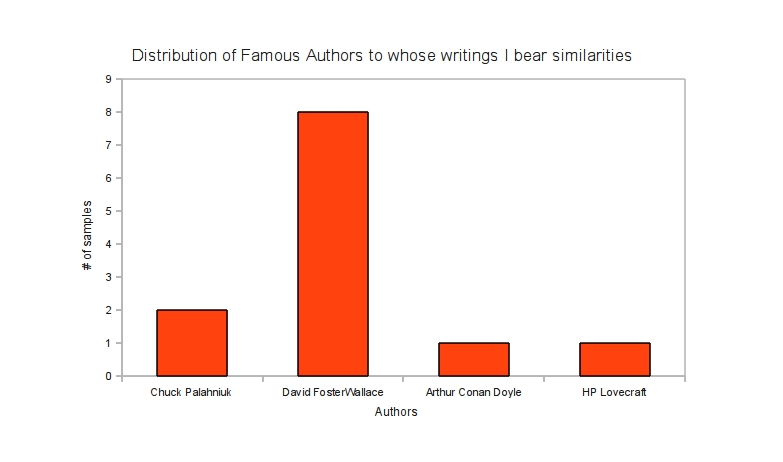
One recent meme making the rounds on the Internet is the site “I write like…” I haven’t looked into the algorithm yet, but I’m not sure if I can. It isn’t obvious on the website what the statistical analysis entails. But of course, I was curious about my writing style. Some preliminary findings:

1) Repeated submissions with the same text results in the same author

2) Of the 12 samples I submitted (all from this blog), I got the following results:

The Arthur Conan Doyle hit is an interesting one. It came from my post on James Patterson’s King Tut book. Part of the algorithm must account for theme/genre, probably based upon a concordance. There’s no reason to think that I changed my style so much when I wrote about crime. The algorithm might have narrowed the field down using certain keywords, and then selected an author.

What I write here are essays. I’m not sure what it means to bear similarities to (mostly) fiction authors.

I am mildly insulted by the HP Lovecraft: perhaps that post rambled and didn’t come to a point?

All in all, a nice bit of fun.

Update: It turns out I was on the right track regarding “keywords”. Here’s a report from the Huffington Post, which contains a few words from the author of I Write Like.

While I thought the movie Sideways was funny enough, it wasn’t a movie I would enjoy rewatching; I detested Paul Giamatti’s and Thomas Hayden Church’s characters, Miles and Jack, respectively, in that movie.  The one standout scene in that movie, for me, isn’t when Miles talked about how much he likes pinot noirs – which is just a self-pitying comparison between him and the grape. (That is, the care and cultivation needed for that grape to reach its full potential as a wine is the same care that a woman needs to give to him. Really. The effort expended on the grape is less aggravating, since the grape isn’t boorish and doesn’t talk back. Why should anyone, even his mother, spend that much attention on him?)

No, the scene that made me feel some sympathy toward Miles is his guzzling his prized bottle of wine (a 1961 Château Cheval Blanc), from a styrofoam cup, in a fast food restaurant, after he found out his ex-wife is pregnant. I believe that’s the occasion he was saving that bottle for, with them still being married and finding out they are expecting  (or nowadays, probably waiting until she gave birth and finished breastfeeding). In a nutshell, one can see that maybe the wife didn’t share all his interests, and that he had spent way too much time indulging in his own passion while not sparing any for his wife. It is sad, and seems a common affliction.

I am not the first to point out that a number of books and movies that focus on unattractive, compulsive, abusive, jerky men who luck into wonderful relationships with walking sex fantasies with a heart of gold and infinite patience. The writers are writing about their own desires, and these writers are all white, middle-aged men who, if we assume that these movies and books express their ideas about relationships, do not work at building friendships. These men sound like assholes.

And so we finally come to Juliet, Naked, the story of Annie, Duncan, and Tucker. Annie is an intelligent woman, stuck in a dead-end relationship with Duncan. Duncan is obsessed with a musician (Tucker) who disappeared during a tour; he was not seen nor heard from again. However, a core of diehard fans kept paying tribute to Duncan in the form of website and forum, trading in bootlegs and speculating about why Tucker turned away from the life of a rock star. They share stories about pilgrimages to locations deemed an important part of Tucker’s life.

As one imagines, the problem is not the compulsive behavior of these men, in the microscopic examination of every shred of public evidence of Tucker’s life. A major problem is in how these men feel Tucker owes them access to his life, to the point where fans try to intrude on his life.

However, I think a small part of the novel deals with  fan behavior; Hornby is gracious enough to recognize that some fans look weird and obsessive because most other people make them out to be weird. It is expected, until the advent of web based tools that let artists easily engage in self-promotion, that artists keep distance from their audience. I would suppose that artists would prefer that fans don’t talk back and certainly not to break into the homes of people who have some relationship to them.

At any rate, spending a vacation touring suburbs and bathrooms in the Midwest suggests that Duncan is a pathetic, infantile man who cannot move on. Of course, it also describes Annie, and her situation is even worse because she won’t or can’t leave Duncan, despite his problems being abundantly clear to her.

Things change in Duncan’s and Annie’s life when she opens mail intended for Duncan. The package contained a disc of unreleased material; it is basically a draft of Juliet, a record Tucker had released, and dubbed Juliet, Naked. Annie listens to it and concludes that the produced version is much better. This differs from Duncan’s view, and eventually their relationship breaks under the strain. Annie also writes out her thoughts about “Naked” on the Tucker fan site, managing to catch Tucker’s attention.

There are some interesting ideas here, mostly in how it is much easier to cultivate a relationship with someone who doesn’t reciprocate (in this case, it’s Tucker.) By traveling the same tour path as Tucker, by interpreting his music, and by doing everything short of treating Tucker like an actual person, Duncan and his compatriots can indulge in their pop psychology analysis of Tucker, of his drive and motivation. In short, fans like Duncan can project their own desires onto Tucker.

From my reading, Hornby’s books tend  examine the many different ways men engage in these one-sided relationships. It is much easier being a fan of a soccer team, ranking musicians, and generally being self-absorbed. Again, the idea of being a fan is to establish ones identity relative to the object of his obsession. It isn’t so much admiration as a mirror. The men interpret the art or the game or the players as they like (and it is their right), but it never seems as if they ever considered that the artist or the players may have their own views.

A major part of the work is in the idea of interpretation and how much an author has control over the nature of his works’ impact. There is one good bit with Duncan, towards the end of the novel. He meets Tucker and sees that Tucker isn’t the person Duncan has in mind. We also found out that these obsessives have staked a lot worship on the wrong information. They live on rumors about Tucker’s underground gigs, his supposed influence in production or writing of songs, and sightings of a person who isn’t even Tucker. So real Tucker doesn’t conform to Duncan’s idea of the man. We find out that Tucker also feels like that he can’t recognize the person he was anymore.

Tucker, it turns out, left music because he felt that his anguish over losing the love of Juliet, made tangible by his writing the songs on the record Juliet, was fake. He realized, while on tour, that he might actually love his new infant daughter more. That relationship may be more meaningful than young love. Perversely, he felt this feeling distanced himself from his own music, because whatever he wrote would be fiction. The music would no longer be authentic.

Duncan’s moment comes after this revelation. He argued the less creepy and more meaningful point that while an artist has his own motivations in creating a work of art, he cannot control how others perceive the piece or what meanings they take from it. Art inspires, but it is a mistake to think that it is an exact science in what feelings other take away. The important thing is that people take something from the piece, even if the artist loses touch with his own work.

This is the very argument I would use to justify me writing these musings about books I read. I was wrong to describe this blog as a series of book reviews. It is a collection of thoughts about books; ideally, I connect these ideas to themes from other books I read and, I hope, relatively novel thoughts I have based on my experience.

I would take the Duncan argument a step further; an artist shouldn’t feel inauthentic if his motivations and passions change. The sculpture, book, song, painting, photograph, or whatever, probably came from an authentic place, at the time the piece was created. If life happens and the artist feels differently later, what’s wrong with that? Why can’t he grow or regress? Why not author something new?

One final note: I suppose the Duncan argument runs a bit close to the post-modernist’s “textual analysis” justification. Everything is open for debate; meaning is in the eye of the beholder; there is no primary interpretation, thus ignoring the author’s own ideas, as if he has no idea why he created a work of art. This is a philosophical difference I am not reconciled with. I think that art should have some meaning or motivation. This comes from my finding art an absolute waste of time when the artist has no point of view. Rather, if his point-of-view is that he wants to say everything about everything, where symbols mean all things to all people, he says nothing at all. What I want from art is a particular thought, or feeling, something that convinces me that the author/painter/musician had something specific in mind. I don’t want to go to an artshow to look into a mirror, where I leave with what I  brought. I want to hear what the artist has to say, and think about it, and agree or disagree with it. With that said, of course individual interpretation has value; it’s just that I prefer it when the artist treats me with respect and has enough confidence in his own ideas to be specific. The problem is, this does require that an artist uses his vernacular to establish a framework for interpretation. That is, there is a so-called primary interpretation – that is, a true meaning – even if at a very skeletal level. Isn’t that the point of language, and, more generally, communication? Why write, speak or draw if the audience simply edits things on the fly to fit his own preconceptions? I do feel that interpretation is and should be constrained, and I do not respect artists who abrogate this basic responsibility.